Let me tell you about the patient who did everything right.
She is thirty-one, a freelance graphic designer with no employer to hand her an insurance card, so she went out and bought her own coverage on the marketplace — exactly the way we told her to. For four years it worked. She had a plan that, because of the Affordable Care Act, could not turn her away for being a woman of reproductive age, could not charge her more for the cesarean on her chart, could not call a past pregnancy a "pre-existing condition" and price her out of the pool. Maternity and newborn care were covered because the law names them essential health benefits and forbids the plan from carving them out. Her birth control cost her nothing at the pharmacy counter, because the law requires that too. On paper and in fact, she was safe.
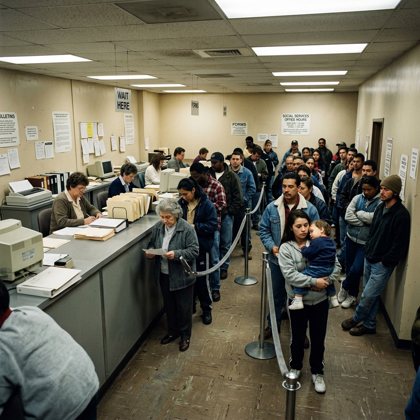
Then, in January, she opened her renewal notice and the number had doubled.
I want to walk you through what happened to her, because it happened to millions of women in the same few weeks, and almost none of them saw it coming.
Here is the machinery. In 2021, the American Rescue Plan created enhanced premium tax credits — subsidies that capped the share of her income any family could be charged for a marketplace plan and, for the first time, extended help to middle-class households that had always earned just enough to be shut out. The Inflation Reduction Act carried those enhancements forward. They worked the way good policy is supposed to work quietly: marketplace enrollment climbed to a record 21.3 million people by 2024. For a woman doing gig work, freelancing, or clocking in at a small business with no benefits, that card was the difference between having a doctor and hoping she wouldn't need one.
Those enhanced credits expired on December 31, 2025. Congress simply let them lapse, and the marketplace snapped back to its stingier, pre-2021 self overnight.
The enhanced subsidies expired. The plans did not get cheaper — only the help did.
The plans did not get cheaper. Only the help did. And so the price the patient actually pays went up — hard. Across the marketplace, the average premium people pay out of their own pockets, after credits, rose 58 percent in a single year, from $113 to $178 a month; for enrollees who tried to keep the exact plan they had, the sticker was worse still — the kind of increase that more than doubles what you were paying. Deductibles climbed to a record, up more than a thousand dollars per person, to $3,786. That is not a rounding error in a household budget. That is the cost of the anatomy scan. That is the reason she cancels it.
The Congressional Budget Office told us, before any of this took effect, exactly what this would do: stacked on this year's Medicaid cuts, letting the enhanced credits lapse is projected to push more than 14 million more people off their health coverage by 2034. When you remember that about 8.9 million women ages 19 to 64 — 9 percent of women that age, the same rate as men — buy their own coverage on the non-group market, you understand who is inside that number. Hundreds of thousands of them are losing not a line item but a medical home — trading the doctor they saw before they were sick for the emergency room they'll reach after.
I want to be specific about who gets hit hardest, because the damage is not evenly spread.
There are women who fall into the gap. Ten states still refuse to expand Medicaid — most of them in the South, Texas the starkest case, where one in five women is uninsured. A woman there who lives below the poverty line already qualifies for nothing: she earns too much for her state's threadbare Medicaid and too little to reach the marketplace subsidies, which by law do not extend below the poverty line. KFF counts roughly 667,900 women stranded in exactly that gap. For the near-poor women just above them — the ones who did qualify for subsidized marketplace plans — the enhanced credits were the bridge that kept coverage in reach. Take the credits away and more of them slide toward the same trap: earning too much for Medicaid, too little to afford an unsubsidized premium, eligible for nothing.
There are women who buy the illusion of coverage. To avoid going bare, many are steered into short-term, limited-duration plans — the ones the ACA explicitly exempts from its rules. They are cheap for a reason: because they sit outside the ACA, they are free to do exactly what the law forbids compliant plans from doing — leave out maternity care (which the ACA had to name a required benefit precisely because individual-market plans used to omit it), deny you for a pre-existing condition, and cap what they'll pay. A pregnant woman holding one of these plans is, in every way that matters at the moment of delivery, uninsured — she just doesn't know it yet.
There is the quiet collapse of contraception. The ACA requires marketplace plans to cover FDA-approved birth control with no cost-sharing at all. Lose the plan you could no longer afford, and you lose the free contraception with it — a stealth defunding of the most reliable tool we have for preventing the unintended pregnancies this same politics claims to want fewer of.
And there is the mental-health cliff. Marketplace plans have to cover mental-health and substance-use care as essential benefits. Sever the plan and you sever the therapist and the prescription in the same stroke, in the middle of a maternal mental-health crisis we are already losing.
Now let me tell you why I, as an obstetrician, read all of this as a clinical emergency and not a budget story.
Losing coverage does not make a woman decide to be reckless. It makes her rational in a way that kills her. The total cost of having a baby in this country runs to roughly $19,000 to $20,000 when you add up the pregnancy, the birth, and the care afterward — a bill an insured woman never sees in full, and an uninsured one is handed whole. Faced with that arithmetic, she starts trimming. She skips the copay she can see to avoid the bill she can't. She reschedules the 20-week anatomy scan, then reschedules it again, then lets it go. If she has diabetes or high blood pressure and can no longer fill the prescriptions between pregnancies, she walks into the next one already sick — with the uncontrolled sugar or pressure that becomes the severe preeclampsia, the abruption, the stroke. And when the warning sign finally comes — the headache that is not a headache, the bleeding that will not stop — she waits, because she knows an uninsured trip to the emergency room is its own kind of catastrophe. She waits until the window for a simple fix has already closed, and what could have been managed in a clinic becomes a code called overhead.
She does the math a rational person does, and the math is what kills her.
This is the part I need said plainly. We did not lose the knowledge to keep these women well. We did not hit the limit of what medicine can do. We took away the card that let them reach it — and we did it on purpose, with a vote, knowing the number. The plans did not get cheaper. We just stopped helping women pay for the one thing standing between an ordinary pregnancy and an emergency.
That is a choice. It can be un-chosen.