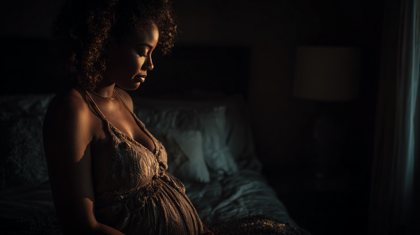
The fever I almost sat with was one hundred and three. The thing I kept telling myself, for hours, was that I was probably just engorged.
I want to tell this one as the patient, because for once the patient is me. And I was, by every measure the public-health literature would use, the woman the system is supposed to protect. I have good insurance. I live in the South, but I live in a city, with private doctors and their private numbers in my phone. The badge was in the drawer. The plan card was in the wallet. Whatever protection income and education are supposed to buy a Black woman, I had bought it in full.
This was after my second delivery. What I had, in the days that followed, was an unrelenting headache and a fever that climbed through an afternoon. In retrospect — and it is the retrospect that haunts me — I think I may have had severe preeclampsia. I knew, in the part of my mind that has lived in the obstetric literature for fifteen years, that engorgement does not produce a temperature of one hundred and three. I knew that a headache that will not let go, in the weeks after a birth, is enough to earn a workup on its own. I knew the exact list of things the fever and the headache and the hours I was letting pass were buying me. I knew all of it, and I sat with it anyway.
I need to be honest about why, because the why is the whole point. It was not ignorance. It is that I am a Black woman, and the women I come from — the ones who climbed — do not let ourselves be the patient. We are the one who shows up for everyone else. We are the one with the next thing already on the calendar. We have been told since we were small that the world will demand an excellence of us it does not return, and somewhere in that we learned that the threshold for being taken seriously as sick is higher for us, and that crossing it early is not a thing we are permitted to do. You are never quite educated enough to stop being a Black woman. The plan card was in a bag on the floor of a room I had not, in the first hours of a postpartum fever, gotten dressed to leave.
"You are never quite educated enough to stop being a Black woman."
So the hours passed, and the fever climbed, and the thing the literature had taught me receded behind the older, deeper instruction — that I should wait, that I should be sure, that I should not make a fuss. The income did not protect me from that instruction. The education did not. The private doctors did not. When I finally walked into the hospital, it treated me well; the hospital was never the problem. The problem was that I had spent hours at home with a temperature of one hundred and three because a lesson my body had absorbed across forty years was louder than everything I had been trained to know.
Here is what that hour taught me. The protective effect of income and education on Black maternal outcomes is, in large part, a story we tell ourselves about a thing that was never structurally underwritten. The instruction does not switch off when your salary crosses a line. The threshold for calling for help is one of the most consequential things about a postpartum course, and it is the one no dataset can see. The data can only count the woman who came in. The woman who waited an hour too long — who told herself it was engorgement while the fever climbed — is filed, in the numbers, as one of the women the protection was supposed to have covered. In the reality of that kitchen, the protection never reached her.
What I can do now, I do in the room. I have a patient I am discharging today, a few days out from her own delivery. Her pressures are good. Her chart says her support system is strong. She has the look I know from the inside — a woman being told she gets to go home, holding the quiet grief that the hard part starts in the parking lot. I sit on the edge of her bed longer than the chart would predict. I tell her the numbers to watch. I tell her that the most dangerous stretch of a pregnancy is the one that begins when she walks out this door — because the postpartum weeks are when the body does work the discharge sheet does not name, and when a large share of maternal deaths actually occur. I tell her that a headache that will not go away is not engorgement. That a fever that climbs is not engorgement. And because she is a Black woman climbing the same rungs I climbed, I tell her the thing the sheet will never say: that the instruction in her head will tell her to wait, and that she should call before she is sure. I write my number on the sheet in a hand she can read. I tell her I would rather be called and be wrong than not be called and be right.
"I would rather be called and be wrong than not be called and be right."
What I cannot do, from inside that room, is repair the thing that is actually breaking. I cannot restore the federal job that vanished in the spring, or the program that closed, or the badge that no longer opens a door. Those rungs are being sawed off while I write this — and the internal instruction they were supposed to offset is still being delivered, at full force, to the same women whose economic footing has just been pulled away. The stress does not retreat. The threshold does not drop. For the woman climbing the next rung in 2026, that hour at home with the climbing fever is going to get longer, not shorter.
I think often about the friend who was on the phone that afternoon — the one who finally said, go in. She was the rescue. She is not in any chart. She is, in the language of my field, an exposure variable no dataset records. And every intervention the literature calls most actionable — a full year of postpartum coverage instead of a cliff at sixty days, a Black physician at the receiving end of the call, a doula in the room, a discharge sheet that names the threshold out loud — is, in the end, a way of building that friend into the system, so that a life does not have to depend on who happened to pick up the phone.
The patient I discharge today does not know any of this. She knows the doctor sat on her bed a while, and wrote a number she can read. She does not know that the number is the thing I would have wanted on a piece of paper in my own kitchen, the day my fever was one hundred and three.
The income did not protect me. The education did not protect me. The thing that protected me was the friend on the phone. The work of this decade is to make the friend a permanent feature of the discharge — so that it is not luck, and it is not a favor, and it does not depend on a woman deciding, an hour too late, that she is finally sick enough to be believed.
We can say that plainly. We have to.